

Found in the audit, not reported by the client
A regional B2B service provider, nine locations inside their service radius. One location page each, built by the previous agency as part of a complete SEO package.
Nobody reported a problem. I found it during the onboarding audit, mapping the site’s architecture: a cluster of pages targeting the same services, with no hierarchy between them.
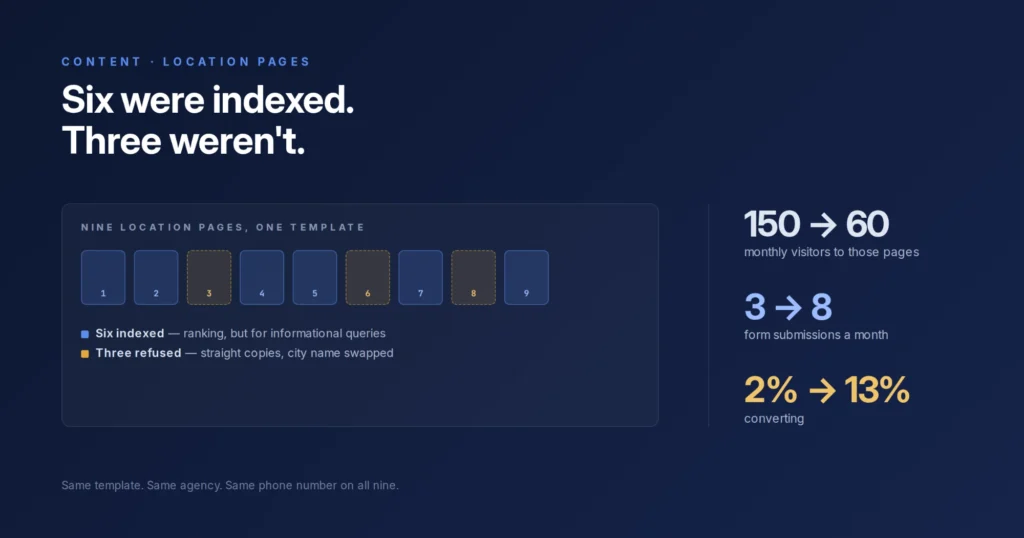
Six were indexed. Three weren’t.
That was the question. Nine pages, same template, same agency, same service. Google kept six and refused three.
So I went to Search Console and asked what made those three different.
They were straight copies. Same text, different city name at the top. All nine carried the same phone number, but the six had enough variation on the page to survive. The three had nothing.
What Search Console showed, in order
First: Duplicate, Google chose different canonical than user.
Google had crawled the pages, decided they were versions of each other, and picked one as the real one. The rest were folded into it.
Then, later: Crawled, currently not indexed.
Google stopped bothering. It had seen enough of these pages to conclude there was nothing new on them.
That order matters. Most people only ever see the second status and don’t know what preceded it. The pages weren’t rejected on arrival. They were consolidated first, then dropped.
In the performance report, no single URL held steady ownership of any query. The page Google showed for a term changed from one week to the next. Nine pages taking turns at losing.
The six had a different problem
The three copies were never going to rank. Google had told me that twice, in two different statuses.
The six were ranking fine. If you only looked at the rankings, nothing was obviously wrong with them.
But they were ranking for informational queries. What is this service. Why does it matter. How does it work. That’s top-of-funnel traffic landing on what should be a bottom-of-funnel page.
A location page has one job: someone looking for this service, in this place, ready to buy. It isn’t there to explain the category.
Same root cause, two symptoms. The agency built pages to fill a slot, not to do a job. Three were too thin to index. Six were indexed and pointed at the wrong people.
What I changed
I built a content sitemap first. One highly specific primary keyword per page, so each page owned its own local term instead of bleeding into the others.
Then I rewrote the pages for commercial intent, with real local signals rather than decorative ones. The informational content wasn’t deleted. It moved to resource and service pages, where top-of-funnel readers are supposed to find it.
Informational content isn’t the problem. People at the top of the funnel need it. It just doesn’t belong on a location page.
What happened
The three pages that had never been indexed were indexed about six weeks after the rewrite.
The six that were already ranking improved, some as high as the top 3.
The traffic and enquiry numbers took about three months to settle.
Traffic to the location pages dropped from about 150 visitors a month to about 60. That traffic didn’t leave the site. The informational queries now land on the resource and service pages built for them.
Form submissions from the location pages went from around 3 a month to around 8.
Roughly 2% converting to roughly 13%.
Site-wide traffic moved 2 to 3% over the same three months. Barely anything. The client was happy because the enquiries nearly tripled.
If you only read the traffic chart for those pages, this engagement looks like a failure.
The pages stopped appearing for terms they never owned. The people who arrive now are on the page that matches what they came for.
What makes a location page worth having
The reason these pages fail is that they all say the same thing with a different name at the top.
A location page needs to stand on its own:
- What that location actually does, and what it commits to
- Work from that location, not stock examples
- Its own contact details
- Its own primary term, not shared with eight other pages
Copying the service description across locations is fine. The page still has to be unique and standalone beyond that.
Schema won’t rescue a copy
Some agencies add LocalBusiness schema and a paragraph about the city’s history, and call it differentiated.
The schema isn’t the problem. It’s correct on a location page. The problem is using it to make a copy look different. A signal is supposed to describe something real, not stand in for it.
What I do when I inherit pages like these
- Audit the pages.
- Build a content sitemap to give the site structure.
- Assign a specific keyword to each page.
- Merge, if needed. Rewrite, if needed. Delete, if needed.
If needed. I don’t recommend changes so I have work to do.
There’s no one system that fits all of them, which is the whole point. Anyone can build a content sitemap. Deciding which of the nine pages survives is sixteen years of judgement, and that’s what the work actually is.
If you’ve got location pages that aren’t ranking, start with the Kreametrix Audit. For the structural work, see Content and topical authority and Local SEO.