

The request that didn’t survive the research
A landscaping company in Florida, expanding into Arizona. They wanted a location page and a Google Business Profile, targeting luxury landscaping near me.
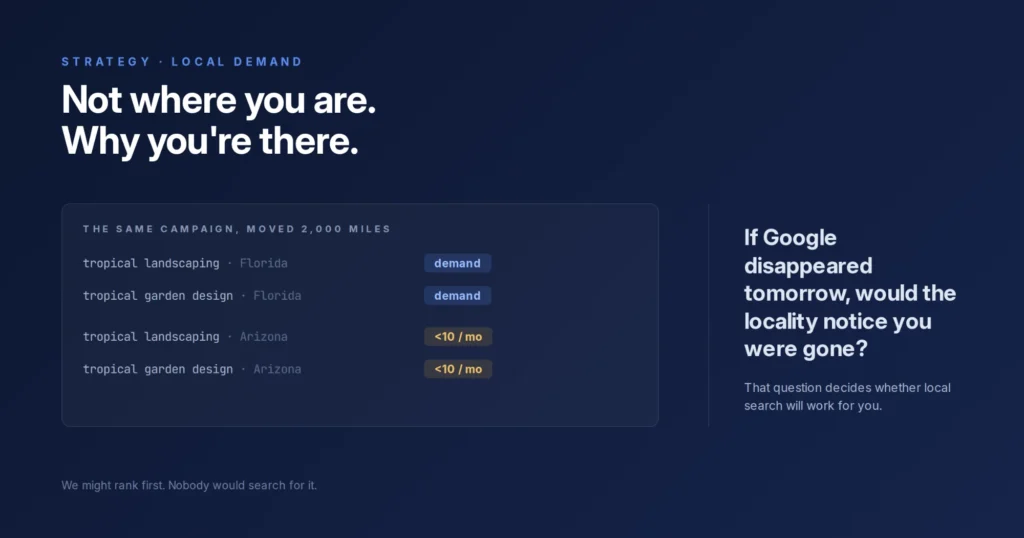
In Florida the campaign worked. Green lawns. Tropical landscaping. Tropical garden design. Those terms had demand, and the business delivered on them.
I said yes at first. Then I started searching.
The Florida terms had almost no volume in Arizona. Under 10 searches a month on the ones that mattered. I checked Keyword Planner and SE Ranking and the gap was enormous. Keyword Planner reports low volumes in ranges rather than exact numbers, so “under 10” is as precise as it gets, and it was precise enough.
That’s not a ranking problem. Arizona is desert. Nobody there is looking for a tropical garden, because a tropical garden is the wrong answer to the question their climate is asking.
So I told them copying the campaign wasn’t an option. We might rank first, and nobody would search for it.
What the owner said
He agreed, and then he said the thing that stayed with me. He hadn’t realised. He’d assumed that as long as he ranked high for luxury landscaping, it was good.
That’s the mindset this post is about, and it’s extremely common. Rank high, get found, get customers. Each step assumed to follow from the last.
We rebuilt the Arizona campaign instead. Different descriptions, different content, different images, different services. Tailored to the place rather than transplanted into it.
Where the business is, or why it’s there
Most businesses think about “near me” as where they are. An address, a service area, a set of fields in a profile.
I think about it as why the business is there.
Each locality has its own preferences, its own traditions, its own way of living. “Near me” is someone saying this service should exist here and I don’t know who provides it. That’s a demand signal, and it’s either present or it isn’t.
Your profile can’t create it. Neither can your page.
The question I’d ask before anything else
If Google disappeared tomorrow, would the locality notice your business was gone?
That’s not a philosophical question. It’s the one that decides whether local search is going to work for you.
If the answer is yes, the search work is just making something visible that already exists. If the answer is no, you’re asking a search engine to vouch for a relationship you haven’t built.
Search visibility is the readout, not the asset
Reviews, mentions, recommendations, people coming back. That’s what a relationship with a locality looks like when it shows up in data.
You can’t build those directly. They’re the consequence of being worth recommending.
Which is why businesses that try to fix the readout never get far. Adding cities to a profile, collecting reviews as a task, writing a paragraph about the town’s history on a page that’s otherwise identical to eight others. I wrote about that last one already. The signals are supposed to describe something real.
A test for a location page
Could this page be true in another city with just the name swapped?
If yes, it doesn’t belong to either place. It isn’t saying anything about what that community needs or what you understand about it. It’s saying you’d like to be found there.
A page that earns its place knows something: what people in that area actually ask for, what the local rules are, what the common problems with the houses or the soil or the weather are. That knowledge is the local signal. The address is just an address.
You can’t conjure demand
People hire me expecting a certain kind of magic. Make us appear, get us to the top, bring in the calls.
But if fewer than ten people a month are searching for what you sell in the place you sell it, there’s nothing to optimise. Search and paid ads capture demand that already exists. They don’t create it.
Telling a client that costs me work. It’s still the first honest thing I can say, and it’s the question I’d want answered before anyone spends money: is my business needed in the locality I want to serve?
Sometimes the concept is good and the place is wrong. That’s not a marketing problem, and no amount of local SEO will fix it.
Change the offer, change the market, or accept that search isn’t your channel.
No matter how good I am at marketing, people in Arizona still won’t need a tropical garden.
What this means practically
- Check demand before you build. Not rankings, demand.
- If the demand is there, build for what that place actually asks for.
- If it isn’t, the problem is upstream of marketing.
- Treat reviews and recommendations as evidence of the relationship, not as work.
If you’re trying to work out whether local search is worth it for your business, start with the Kreametrix Audit. For the structural work once the answer is yes, see Local SEO and Google Business Profile optimisation.